

Tailored Vendor Portals

Vendor portals, especially tailored ones, are powerful business tools that can address numerous pain points in your current accounts payable operations. Vendor portals can provide a platform for vendor self-service that can have immediate financial and human resource impacts on your organization. Not all vendor portals offer the flexibility and configurability to help you address the areas of concern and inefficiency your organization may be dealing with, though. When selecting a vendor portal, ensure that the solution can address areas of pain where you need relief.

Benefits of Tailored Vendor Portals

Vendor Portals are extremely helpful for both the buying company and the vendors themselves. Vendors participate in self-service, allowing both sides to save time and money. However, not all vendor portals are created the same. Your business processes and specifics may not be reflected in off-the-shelf products. Vendor Portals with tailoring possibilities make it easier to interact with your vendors. You also only have to pay for the functionality that your organization uses.

The chart below illustrates this point by listing common areas of pain in AP operations and the corresponding relief provided by vendor portal functionality:

What are your Vendor Pain Points?
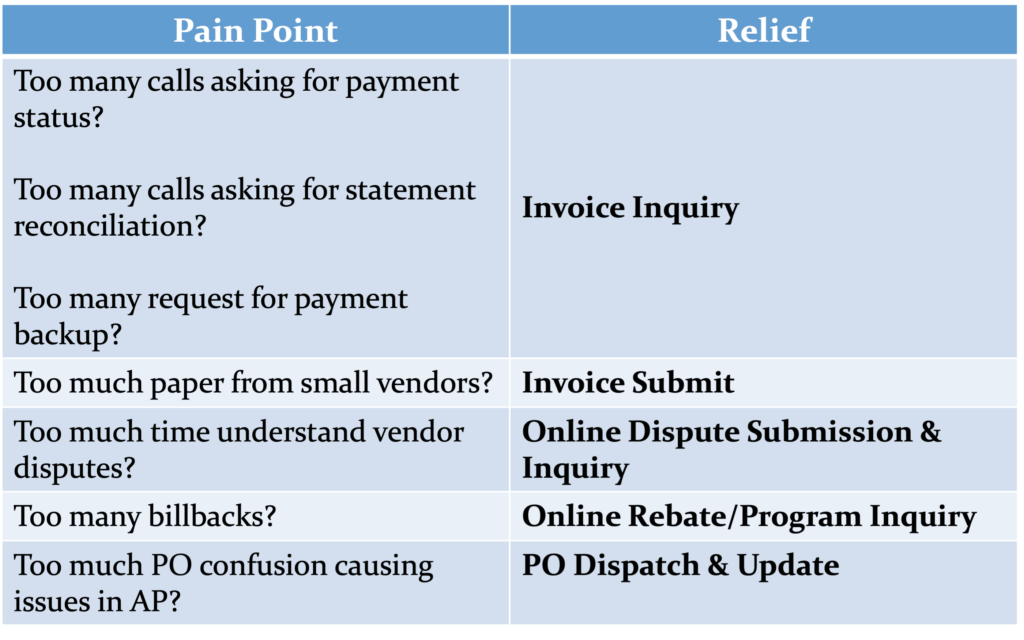
With the different functions of a vendor portal in mind, make an informed decision based on your organization’s needs and decide which functionalities will deliver the biggest bang for the buck. Here are some other things to keep in mind during your technology search:

  • Select functionality that drives the maximum value to your organization
  • Don’t solve ALL the problems, just solve the first one, then move on to the next
  • Progress over perfection
  • Add functionality to your portal based on YOUR organization’s needs

Vendor portals can deliver tremendous value to your company by promoting self-service, assisting in AP automation initiatives, providing a communication vehicle between you and your vendors 24/7, reducing the burden of non-value-added activities for your AP staff, and supporting remote workforce situations for your vendors and your company.

For more information on how tailored vendor portals can add value to your AP operations, contact ICG. Or, schedule a discussion and/or demonstration of vendor portal solutions.

Posts you might like:

How to Decrease Administrative Work in the Financial Back Office

If your back-office team spends 80% of their time chasing missing invoices and fixing typos, you're both losing money on operational inefficiencies and also burning out your talent while missing out on strategic insights. Reducing administrative work in the financial...

The Importance of Considering All Back Office Stakeholders

When a leadership team decides to upgrade its back-office technology, the focus is usually on efficiency metrics, ROI, and cost reduction. But there's a difference between choosing software that looks great during a demo and choosing software that actually succeeds in...

Vendor Portal Technology FAQs

Mid-market companies and large enterprises alike face increasing pressure to scale their supply chains while driving down operational costs. This has made the financial back office primary target for digital transformation. At the center of this modernization effort...

How IDP Transforms the Financial Back Office

In the financial sector, efficiency is an incredibly competitive metric. When financial institutions look at Intelligent Document Processing or IDP, they often view it through a narrow lens: How much time will this save us on invoice processing? How much faster can we...

How to Build a Strong AP Approvals Process

What is an AP approvals process? An Accounts Payable approvals process is a rules-based workflow that determines how a vendor invoice is reviewed, verified, and finally authorized for payment. Building an effective AP approval workflow for your organization requires...

Bolt-on Software Integration vs. Complete System Replacement

What is the difference between a bolt-on software integration and a complete system replacement? A bolt-on is technology that layers directly onto an existing ERP system to enhance its capabilities without altering its core database. Conversely, a complete system...

AP Automation Implementation Challenges

The promise of accounts payable automation is undeniable: lower processing costs, fewer manual errors, faster cycle times, and the ability to turn a traditional cost center into a strategic, data-driven asset. However, deciding to automate is only the first step. The...

7 Things to Look for in an Accounts Payable Solution

Choosing the right accounts payable automation solution is key to the success of the department. As the global AP automation market is projected to reach $6.57 billion this year, organizations are now doing more than just using digital invoices. Now, it's a race...

6 Vendor Onboarding Best Practices

Vendor onboarding is a critical security and operational gateway. With supply chains becoming more interconnected and regulatory scrutiny reaching an all-time high, how you onboard a vendor determines the health of the entire partnership. If your onboarding process...

Key Accounts Payable KPIs for Financial Health

Accounts Payable is a wealth of data that, when managed correctly, protects cash flow and strengthens vendor relationships. To ensure that AP is strategic, it is important to track accounts payable KPIs to monitor how your department is doing. Here are the essential...