

Reasons To Utilize Best-of-Breed Solutions

Like many things, technology and technology-based solutions tend to go in cycles. Lately, the pendulum seems to be swinging back to best-of-breed solutions to address a myriad of business issues. This reverses a cycle where many CIOs chose to use ubiquitous ERP systems to address most of their business processes. While these systems can be powerful and offer significant value, they can also fall short, leaving gaps in processing areas. In this blog post, we will discuss reasons to utilize best-of-breed solutions within your organization’s back office.

Faced with these gaps, organizations either pay for expensive customizations or look to platform partners for complementary solutions. While the large ERP vendors have many “certified” partner solutions in their ecosystems, the business side of their customer base often finds that these partner offerings are not always best-of-breed.

Best of Breed Benefits

When addressing targeted, business, or industry-unique processes, companies are beginning to look beyond their ERP supplier for best-of-breed solutions. Best-of-breed technology refers to a strategy where organizations select the top-performing solutions for specific tasks or functions. The alternative to this is opting for a single, comprehensive suite from a single vendor. This approach allows businesses to maximize efficiency and innovation by utilizing the most advanced tools available in the market. By combining specialized solutions from various providers, organizations can create a customized technology stack that aligns perfectly with their unique needs and goals.

While the ERP remains the system of record and the central platform of their business process, best-of-breed solutions can bridge those functionality gaps that often go uncovered by the ERP’s out-of-the-box functionality. Some of the areas in the financial back-office that have very targeted and configurable solutions include vendor portals, vendor onboarding, AP automation, data capture, workflow management, dynamic discounting, PO dispatch & update, and vendor management. By adding best-of-breed solutions in these targeted solution areas, companies can integrate very powerful and configurable solutions into their back-end ERP or legacy systems.

Bolt-Ons

Bolt-ons are solutions that add functionality to core technology, for example, an ERP. This technology fills the gaps left by rigid systems. They are often best-of-breed because they can specialize in one specific area, instead of having to be all-encompassing technology.
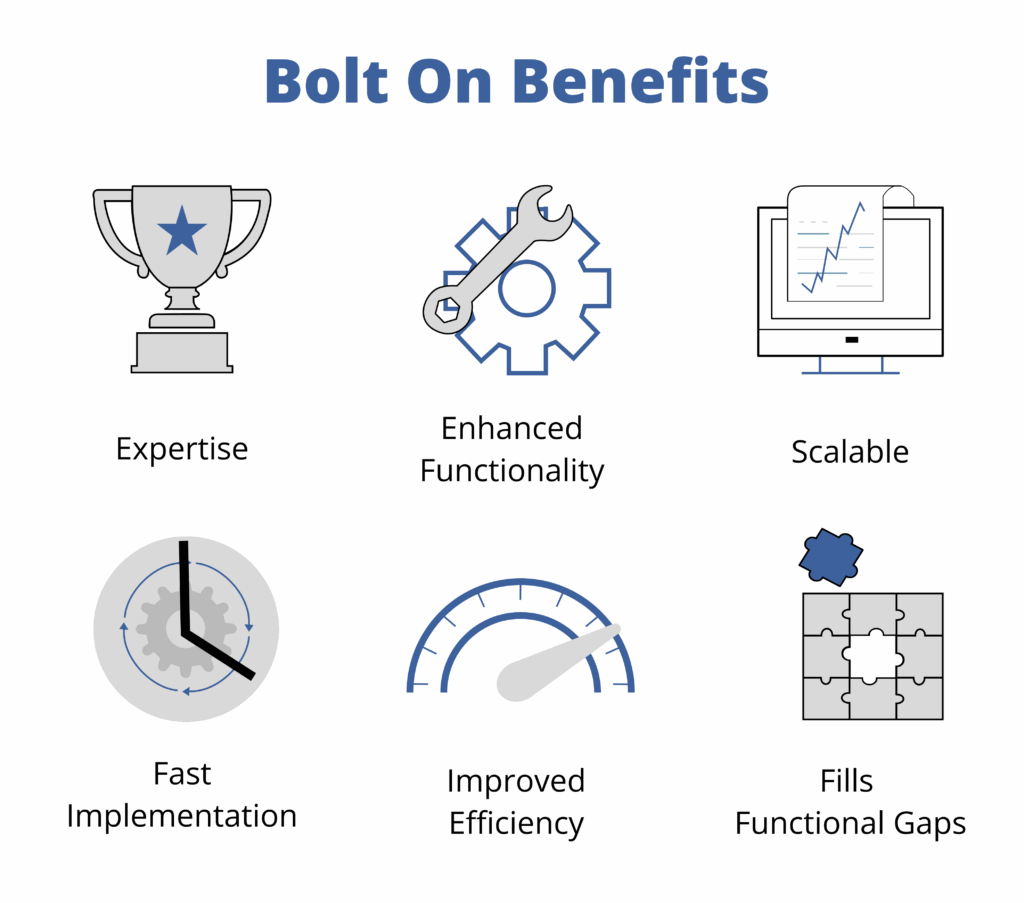
Bolt On Benefits

Get Started

ICG offers a suite of cloud-hosted business process solutions that can fill functionality gaps without needing ERP customizations. Because these solutions are systems-independent, if you change ERP platforms or add additional platforms through acquisition or technology upgrades, you do not need to rewrite or replace any of these solutions.

If you need more reasons to utilize best-of-breed solutions to complement your back-end systems and back-office processing, contact ICG and request a call or a demo of our comprehensive vendor portals or other powerful, cloud-hosted solutions.

Posts you might like:

Why the Back Office Needs Specialized Exception Processing

ERPs record transactions, manage general ledgers, keep inventory aligned, and handle financial workflows. When your transactions follow the perfect path, your ERP operates like a well-oiled machine. However, the real world rarely fits neatly into rigid database rules....

Maximizing Efficiency in the Back Office

From Accounts Payable and procurement to vendor management and financial compliance, back-office processes dictate how fast an enterprise can scale. These functions easily slow down through manual data entry and fragmented workflows. Here is how enterprises are...

7 Steps to Improve Cash Flow in the Financial Back Office

Cash flow is the primary driver of agility, growth, and stability for an organization. Yet, when liquidity tightens, organizations often focus heavily on front-office initiatives like driving top-line sales or renegotiating major debt. In reality, one of the most...

2026 Accounts Payable Technology Trends

For the better part of two decades, digitizing accounts payable has been a top priority. Organizations measured success by whether they could scan a paper invoice, turn it into a PDF, and run basic data extraction to eliminate filing cabinets. That was once the gold...

5 Signs You Need a Vendor Portal

If your accounts payable team spends half their day answering phone calls about invoice statuses or manually typing data into your ERP, your back office is hitting a growth bottleneck. In high-volume financial operations, relying on email and manual data entry is both...

How is IDP Different from OCR?

For years, the financial back office relied on a single technological standard to eliminate paper from accounts payable, procurement, and logistics: Optical Character Recognition. When it first hit the enterprise market, OCR felt like magic. It could take a printed...

7 Data Capture Metrics You Need to Track

Organizations rely on captured data to power machine learning models, personalize customer experiences, and drive business decisions. But how do you know if your data collection methods are actually performing well? And further, what does performing "well" for your...

How to Make the Vendor Onboarding Process a Little Easier

In the financial back office, bringing on a new supplier is rarely a simple admin task. In practice, vendor onboarding is the precise control point where data quality, compliance integrity, and fraud prevention are established for the rest of a commercial...

How to Improve Data Quality and Security

Data is both your most valuable asset and your greatest vulnerability in the financial back office. Every invoice processed, vendor onboarded, and payment executed relies on a continuous stream of financial data. This is why it is key to have good data quality and...

How to Decrease Administrative Work in the Back Office

If your back-office team spends 80% of their time chasing missing invoices and fixing typos, you're both losing money on operational inefficiencies and also burning out your talent while missing out on strategic insights. Reducing administrative work in the financial...