

Choosing the right back-office solutions can feel like navigating a maze. For businesses looking to optimize their back-office operations, the decision may come down to two entirely different solutions: a comprehensive, multifaceted ERP system or a more agile, “bolt-on” solution such as ICG Innovations. Understanding their core merits and differences, as well as your specific business needs, is crucial to making the best choice.
The All-Encompassing Power of a Multifaceted ERP
An ERP promises a single, integrated system that handles virtually every aspect of your back-office operations. These platforms are designed to be the center of your business, offering a unified view of data and streamlining workflows across departments.
Pros of a Multifaceted ERP
- Single Source of Truth: With all data residing in one system, you eliminate data silos and ensure consistency across your organization. This leads to better reporting, more accurate forecasting, and improved decision-making.
- Seamless Integration: Designed from the ground up to work together, different modules within an ERP system communicate effortlessly. This reduces manual data entry, minimizes errors, and automates processes.
- Scalability: As your business grows, a well-implemented ERP can often scale with you. This may include adding new modules or expanding functionality as needed.
- Reduced Vendor Management: Dealing with one primary place for multiple solutions simplifies support, maintenance, and contract negotiations for your vendors.
- Holistic View: A comprehensive ERP provides a 360-degree view of your business, offering insights into performance across various functions.
Cons of a Multifaceted ERP
- High Initial Investment: Implementing a full-fledged ERP can be a significant financial undertaking, including software licenses, customization, implementation services, and training.
- Complexity and Implementation Time: These systems are complex and require extensive planning, configuration, and testing. Implementation can take months or even years, and can be disruptive to daily operations.
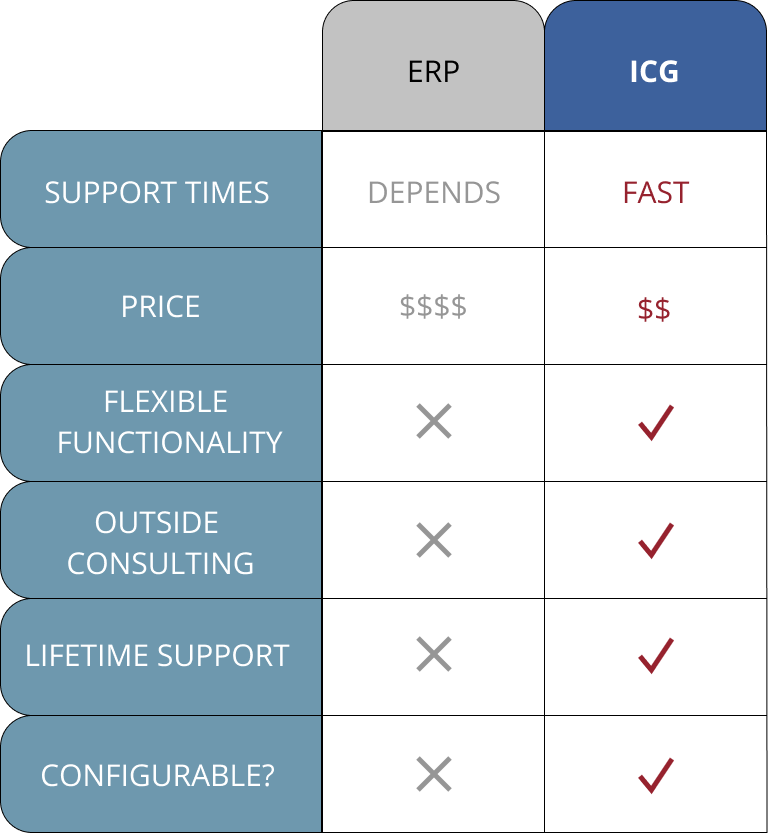
- Rigidity: While powerful, ERPs can sometimes be less flexible when it comes to adopting niche, specialized functionalities that aren’t core to their design. Customizations can be costly and difficult to maintain.
- Vendor Lock-in: Once deeply integrated into an ERP, switching providers can be a complex and expensive process.
- Training Demands: Users will need extensive training to effectively utilize the full breadth of the system’s capabilities.
Why Choose ICG Innovations?
In contrast to the “all-in-one” approach, ICG offers a more specialized solution. ICG’s solutions are a powerful “bolt-on” that enhances your existing ERP without requiring a complete overhaul. ICG focuses on advanced automation or specialized data handling, without deeply altering your core ERP technology.
- Targeted Problem Solving: If you have a specific pain point or a need for specialized functionality (e.g., advanced payment processing, complex expense management, or highly optimized procurement workflows) that your current ERP struggles with or lacks entirely, ICG can provide a precise solution.
- Lower Upfront Cost and Faster Implementation: Bolt-ons such as ICG generally have a lower initial investment and have a much faster implementation than a full ERP system. This means quicker time-to-value.
- Flexibility and Agility: Bolt-ons are often more agile and can be updated or adapted more easily than deeply customized ERP modules. They allow you to adopt best-of-breed solutions for specific functions without disrupting your entire back office.
- Preserve Existing Investments: If you’re generally happy with your current ERP and its core functionalities but need to fill a specific gap, ICG allows you to leverage your existing investment rather than incurring the cost and disruption of a full ERP replacement.
- Reduced Risk: The “bolt-on” nature of ICG means less risk associated with a large-scale system implementation. If ICG doesn’t meet your needs, it’s generally easier to swap out or adjust than an entire ERP module.
- Cloud-Based Benefits: ICG’s cloud-based solutions offer advantages like automatic updates, scalability, and accessibility from anywhere.
Making the Decision
Ultimately, the decision between a multifaceted ERP and ICG (or a combination of both) hinges on several factors unique to your business:
- Your Current State: Are you starting from scratch, or do you have an existing ERP that mostly meets your needs but has specific gaps?
- Budget and Timeline: What are your financial constraints, and how quickly do you need a solution implemented?
- Specific Pain Points: What are the most pressing back-office challenges you’re trying to solve? Are they broad organizational issues or highly specialized functional needs?
- Growth Strategy: How do you anticipate your business growing and evolving? Do you need a system that can adapt rapidly to new requirements?
- Tolerance for Complexity: How much complexity can your organization absorb during an implementation phase?
- Industry Specifics: Does your industry require highly specialized functions that might be better served by a dedicated ICG?
- Multifaceted ERPs are able to perform a multitude of tasks in your financial back office.
- It can be hard to find a multifaceted ERP that meets all of your goals without locking you in to costly ERP upgrades.
- ICG’s solutions bolt on to your existing ERP instead of altering its code.
For businesses undergoing significant transformation or needing a complete overhaul of their core operations, a comprehensive ERP might be the ideal choice for its integrated power and single source of truth. However, for companies that are largely satisfied with their existing ERP but need to add cutting-edge capabilities, optimize a specific function, or move quickly to address a particular challenge, an ICG offers a compelling, agile, and often more cost-effective alternative. To learn more about ICG’s solutions, view this short video or request a demo.