

Reasons To Utilize Best-of-Breed Solutions

Like many things, technology and technology-based solutions tend to go in cycles. Lately, the pendulum seems to be swinging back to best-of-breed solutions to address a myriad of business issues. This reverses a cycle where many CIOs chose to use ubiquitous ERP systems to address most of their business processes. While these systems can be powerful and offer significant value, they can also fall short, leaving gaps in processing areas. In this blog post, we will discuss reasons to utilize best-of-breed solutions within your organization’s back office.

Faced with these gaps, organizations either pay for expensive customizations or look to platform partners for complementary solutions. While the large ERP vendors have many “certified” partner solutions in their ecosystems, the business side of their customer base often finds that these partner offerings are not always best-of-breed.

Best of Breed Benefits

When addressing targeted, business, or industry-unique processes, companies are beginning to look beyond their ERP supplier for best-of-breed solutions. Best-of-breed technology refers to a strategy where organizations select the top-performing solutions for specific tasks or functions. The alternative to this is opting for a single, comprehensive suite from a single vendor. This approach allows businesses to maximize efficiency and innovation by utilizing the most advanced tools available in the market. By combining specialized solutions from various providers, organizations can create a customized technology stack that aligns perfectly with their unique needs and goals.

While the ERP remains the system of record and the central platform of their business process, best-of-breed solutions can bridge those functionality gaps that often go uncovered by the ERP’s out-of-the-box functionality. Some of the areas in the financial back-office that have very targeted and configurable solutions include vendor portals, vendor onboarding, AP automation, data capture, workflow management, dynamic discounting, PO dispatch & update, and vendor management. By adding best-of-breed solutions in these targeted solution areas, companies can integrate very powerful and configurable solutions into their back-end ERP or legacy systems.

Bolt-Ons

Bolt-ons are solutions that add functionality to core technology, for example, an ERP. This technology fills the gaps left by rigid systems. They are often best-of-breed because they can specialize in one specific area, instead of having to be all-encompassing technology.
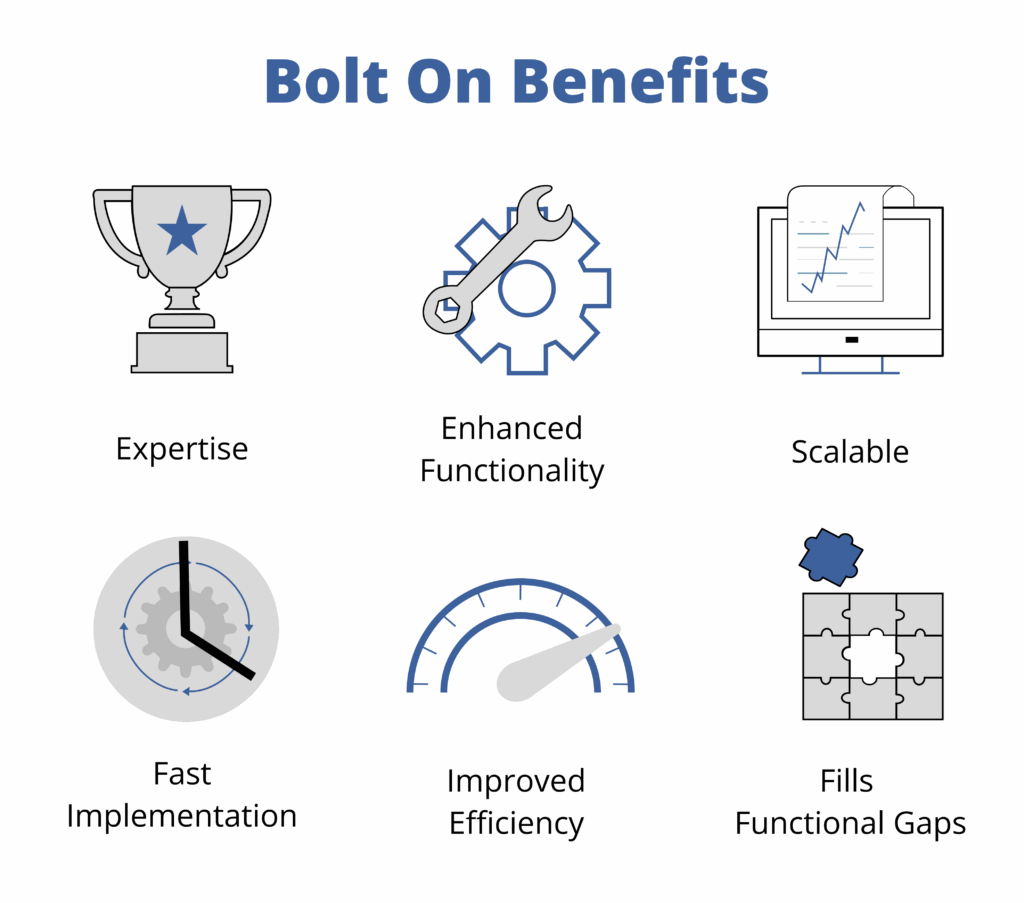
Bolt On Benefits

Get Started

ICG offers a suite of cloud-hosted business process solutions that can fill functionality gaps without needing ERP customizations. Because these solutions are systems-independent, if you change ERP platforms or add additional platforms through acquisition or technology upgrades, you do not need to rewrite or replace any of these solutions.

If you need more reasons to utilize best-of-breed solutions to complement your back-end systems and back-office processing, contact ICG and request a call or a demo of our comprehensive vendor portals or other powerful, cloud-hosted solutions.

Posts you might like:

How to Decrease Administrative Work in the Financial Back Office

If your back-office team spends 80% of their time chasing missing invoices and fixing typos, you're both losing money on operational inefficiencies and also burning out your talent while missing out on strategic insights. Reducing administrative work in the financial...

The Importance of Considering All Back Office Stakeholders

When a leadership team decides to upgrade its back-office technology, the focus is usually on efficiency metrics, ROI, and cost reduction. But there's a difference between choosing software that looks great during a demo and choosing software that actually succeeds in...

Vendor Portal Technology FAQs

Mid-market companies and large enterprises alike face increasing pressure to scale their supply chains while driving down operational costs. This has made the financial back office primary target for digital transformation. At the center of this modernization effort...

How IDP Transforms the Financial Back Office

In the financial sector, efficiency is an incredibly competitive metric. When financial institutions look at Intelligent Document Processing or IDP, they often view it through a narrow lens: How much time will this save us on invoice processing? How much faster can we...

How to Build a Strong AP Approvals Process

What is an AP approvals process? An Accounts Payable approvals process is a rules-based workflow that determines how a vendor invoice is reviewed, verified, and finally authorized for payment. Building an effective AP approval workflow for your organization requires...

Bolt-on Software Integration vs. Complete System Replacement

What is the difference between a bolt-on software integration and a complete system replacement? A bolt-on is technology that layers directly onto an existing ERP system to enhance its capabilities without altering its core database. Conversely, a complete system...

AP Automation Implementation Challenges

The promise of accounts payable automation is undeniable: lower processing costs, fewer manual errors, faster cycle times, and the ability to turn a traditional cost center into a strategic, data-driven asset. However, deciding to automate is only the first step. The...

7 Things to Look for in an Accounts Payable Solution

Choosing the right accounts payable automation solution is key to the success of the department. As the global AP automation market is projected to reach $6.57 billion this year, organizations are now doing more than just using digital invoices. Now, it's a race...

6 Vendor Onboarding Best Practices

Vendor onboarding is a critical security and operational gateway. With supply chains becoming more interconnected and regulatory scrutiny reaching an all-time high, how you onboard a vendor determines the health of the entire partnership. If your onboarding process...

Key Accounts Payable KPIs for Financial Health

Accounts Payable is a wealth of data that, when managed correctly, protects cash flow and strengthens vendor relationships. To ensure that AP is strategic, it is important to track accounts payable KPIs to monitor how your department is doing. Here are the essential...